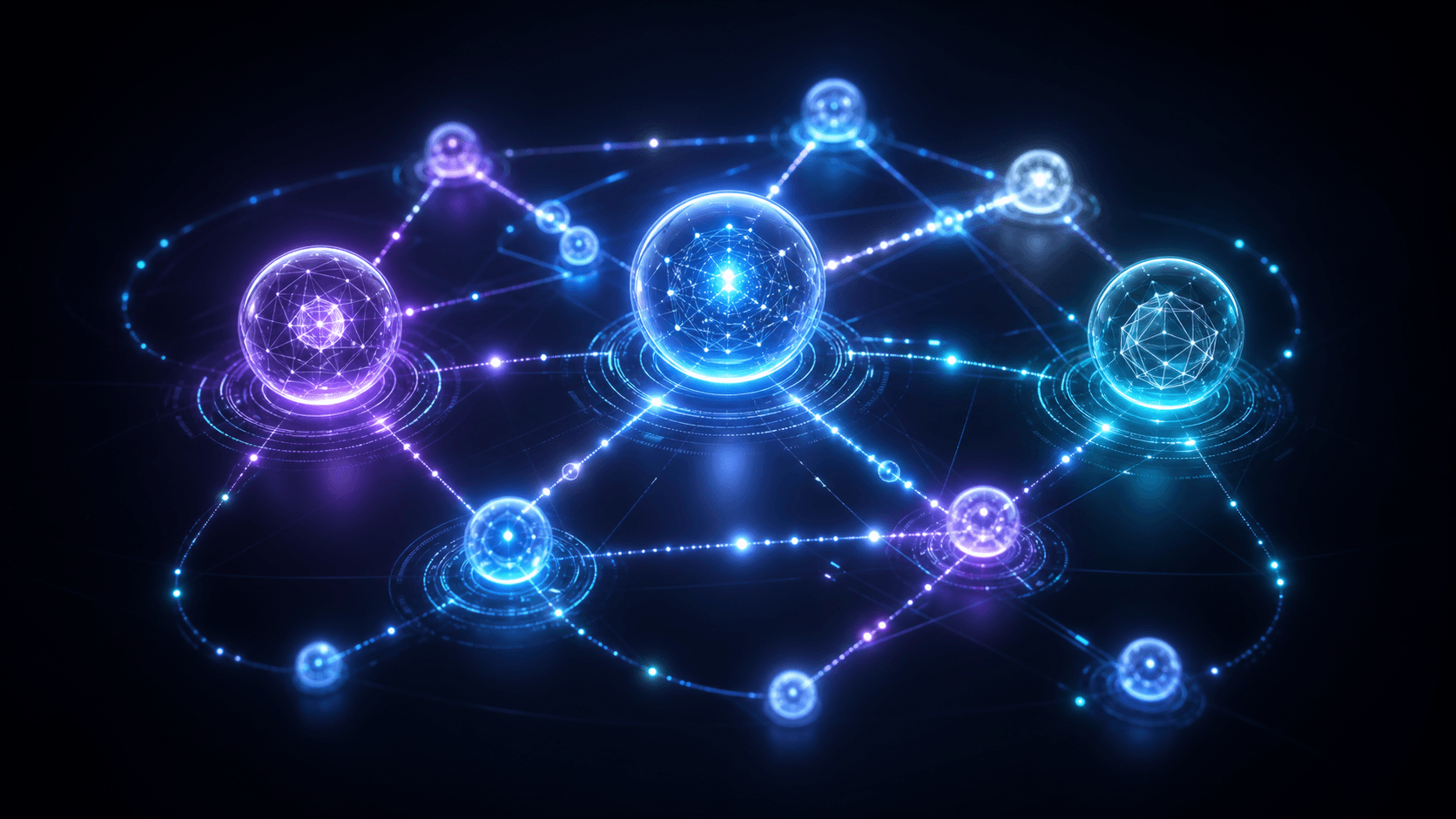
The Multi-Agent Revolution
Just as monolithic applications gave way to microservices, single all-purpose AI agents are being replaced by orchestrated teams of specialized agents. Gartner reported a staggering 1,445% surge in multi-agent system inquiries from Q1 2024 to Q2 2025.
By 2026, 40% of enterprise applications will feature task-specific AI agents—up from less than 5% in 2025.
What Are Multi-Agent Systems?
Multi-agent systems (MAS) involve multiple AI agents working together, each with specialized roles and capabilities:
Single Agent Approach: One general-purpose agent handles everything—research, code, review, tests, docs. This leads to context overload and mediocre results.
Multi-Agent Approach: Specialized agents collaborate—Research Agent, Coder Agent, Reviewer Agent—each excelling at their specific role, coordinated by an Orchestrator.
Why Multi-Agent Systems in 2026?
The Limitations of Single Agents
- Context Overload: One agent handling everything exhausts context windows
- Jack of All Trades: Generalist prompts produce mediocre results
- No Parallelism: Sequential processing slows complex tasks
- Single Point of Failure: One confused agent derails everything
Multi-Agent Advantages
- Specialization: Each agent excels at its specific role
- Parallelism: Multiple agents work simultaneously
- Resilience: One agent's failure doesn't break the system
- Scalability: Add more agents as needs grow
Key Protocols: MCP and A2A
MCP: Model Context Protocol
MCP (introduced by Anthropic) standardizes how agents access tools and resources.
A2A: Agent-to-Agent Protocol
Google's A2A enables peer-to-peer agent collaboration, allowing agents to negotiate, share findings, and coordinate without central oversight.
ACP: Agent Communication Protocol
IBM's ACP provides enterprise governance with security, compliance, and auditing built in.
Multi-Agent Frameworks in 2026
1. CrewAI
Best for team-based workflows with defined roles. Define specialized agents (researcher, writer, reviewer) and orchestrate their collaboration.
2. LangGraph
Best for complex workflows with conditional logic. Create state graphs with agent nodes and conditional edges.
3. AutoGen (Microsoft)
Best for conversational multi-agent systems. Create group chats between multiple assistant agents.
4. MetaGPT
Best for simulating software engineering teams. Hire virtual Product Managers, Architects, Engineers, and QA Engineers.
Orchestration Patterns
Pattern 1: Sequential Pipeline
Research → Write → Review → Publish. Best for linear workflows with clear handoffs.
Pattern 2: Hierarchical
Orchestrator manages Worker agents. Best for complex tasks needing coordination.
Pattern 3: Peer-to-Peer
Agents communicate directly with each other. Best for collaborative reasoning and consensus.
Pattern 4: Blackboard
All agents read from and write to a shared state. Best for complex problem-solving and optimization.
Enterprise Considerations
Governance Framework
Define policies for data access, execution approval, monitoring, and human escalation.
Cost Management (FinOps for AI)
Track budgets per agent, record usage, and alert when thresholds are reached.
The Future: AI Agents as Team Members
By 2028, 38% of organizations will have AI agents as team members within human teams.
Timeline:
- 2024: AI as tool
- 2025: AI as assistant
- 2026: AI as specialist (current)
- 2027: AI as team member
- 2028: AI as colleague
Conclusion
Multi-agent AI systems represent the future of complex task automation. By understanding orchestration patterns, choosing the right frameworks, and implementing proper governance, you can build AI teams that dramatically amplify your capabilities.
The organizations that will thrive are those that recognize agentic AI isn't about smarter automation—it's about new architectures, new standards, and new ways of working alongside AI.
Ready to build your multi-agent system? Let's discuss your architecture needs.